
Te Reo o te Whānau: From Listening to Action
Over the past year, Ngā Uri o Maikuku rāua ko Huatakaroa 1891 Trust has been listening carefully to the voices of our people. Through the 2025 whānau survey and kōrero shared at the AGM, we asked a simple but important question:
what matters most to our whānau right now?
The result is Te Reo o te Whānau: The Prioritised Action Plan 2026–2028, a strategic roadmap that moves the Trust from a phase of listening to one of community-contracted activation. This plan ensures that our work over the next three years is grounded in the lived experiences, aspirations, and priorities of our whānau.
Listening in the Right Way

To ensure we heard a broad and honest range of voices, the survey used a kaupapa Māori approach to engagement.
As outlined in the presentation methodology, three different engagement streams were used:
Digital engagement Online surveys helped capture responses from whānau living across Aotearoa and overseas.
Printed surveys Printed pānui ensured elders and those without reliable internet access could still participate.
Kanohi ki te kanohi kōrero Face-to-face discussions at the October 2025 AGM helped validate and deepen the survey insights.
Together, these approaches helped ensure that the feedback reflects the genuine voice of the hapū rather than a narrow digital sample.
Understanding the Ecosystem of our Whānau
One of the central frameworks used in the plan is Te Pā Harakeke, a model that describes the ecosystem needed for a community to thrive.

The message from whānau was clear: these elements must work together. If one part weakens, the whole ecosystem is affected.
Bridging the Gap: From Stress to Mana Motuhake
The survey also revealed a clear gap between current pressures facing whānau and the future they want to build. Many families described challenges including:

insecure housing and loss of culturally grounded housing models
financial pressure and limited financial capability
isolation and lack of culturally appropriate health services
The aspiration is very different. Whānau want a future where:
housing supports connection to the marae
health services are culturally grounded
financial capability is strengthened
whānau enterprises create economic independence
The pathway forward is about bridging this gap and moving towards mana motuhake, where our people have the resources and autonomy to thrive.
Trust & Governance: The Foundation for Everything
Another major insight from the survey was the importance of transparency and trust.
As highlighted in the “Soil and Roots” section of the plan, the Trust’s social licence to operate depends on equitable governance.
Whānau asked for clearer communication about how decisions are made and how shared resources are managed.
To address this, the action plan includes several governance initiatives:
recruitment of diverse trustees
formal training for governance roles
a strict conflict-of-interest register
regular reporting hui and open communication channels
Without trust, even the strongest initiatives cannot succeed.
Immediate Priorities: Protecting our People
The first stage of the action plan focuses on immediate protection for vulnerable whānau.
Housing is the single most frequently raised issue across the survey, making it the Trust’s number one priority.

Initial housing actions include:
initiating a legal and tikanga review of kuia flats management
developing a priority housing register for marae contributors
identifying potential papakāinga development sites
Alongside housing, the plan also prioritises holistic hauora support for kaumātua.
This includes:
establishing an emergency support fund
exploring affordable rental options for contributing elders
connecting whānau with mental health resources and prevention programmes
Supporting Whānau Through Enterprise
Another initiative emerging from the survey is the development of the Hokohoko Shop, described in the action plan as an immediate relief and enterprise proof-of-concept.
The concept is simple: A community hub providing affordable second-hand goods while supporting circular economy principles.

This initiative aims to address cost-of-living pressures while building a small but stable income stream for the Trust.
A Long-Term Vision for Mana Motuhake
Beyond the immediate priorities, the plan also sets out a longer-term vision for the next generation.

The long-term aspiration is to build a strong economic foundation that supports whānau independence and prosperity.
Funding the Vision
Turning this vision into reality requires a coordinated funding strategy.
The plan outlines a three-year capital flow model that combines:
Internal resources Operational reserves and income from community initiatives.
External grants Applications to funding partners including TPK, HUD, Foundation North, and the Tindall Foundation.
Future capital investment Longer-term funding partnerships to support major projects such as papakāinga construction.
The Trust’s strategy is to use internal resources to de-risk projects and attract larger external investment.
Building the Capacity to Deliver
Ambition alone is not enough. The plan also addresses the need to build organisational capacity.
The proposed pathway includes:

2026 – Foundation Part-time Trust administrator and five working groups covering housing, culture, hauora, economy, and rangatahi.
2027 – Professionalisation Transition to a full-time Trust manager and external development expertise.
2028 – Specialised scale Additional specialist roles depending on funding.
This staged approach ensures the Trust grows sustainably without placing excessive pressure on volunteers.
Managing Risk & Measuring Progress
The action plan also identifies several key risks:
insufficient funding
volunteer burnout
organisational capacity constraints
whānau disengagement
To mitigate these risks, the Trust will use phased implementation, partnerships with external organisations, and a strong communication strategy to keep whānau informed and involved.
To ensure accountability, the Trust has established a dashboard of measurable outcomes for 2026. Key targets include:
implementing Phase 2 of the hapū register
delivering at least four cultural wānanga
establishing the Hokohoko Shop and hosting financial literacy workshops
completing the legal review of kuia flats and identifying papakāinga development sites
These milestones will allow the Trust to track progress and report back to whānau.
Te Ara Whakamua - The Pathway Forward
The next steps are clear.
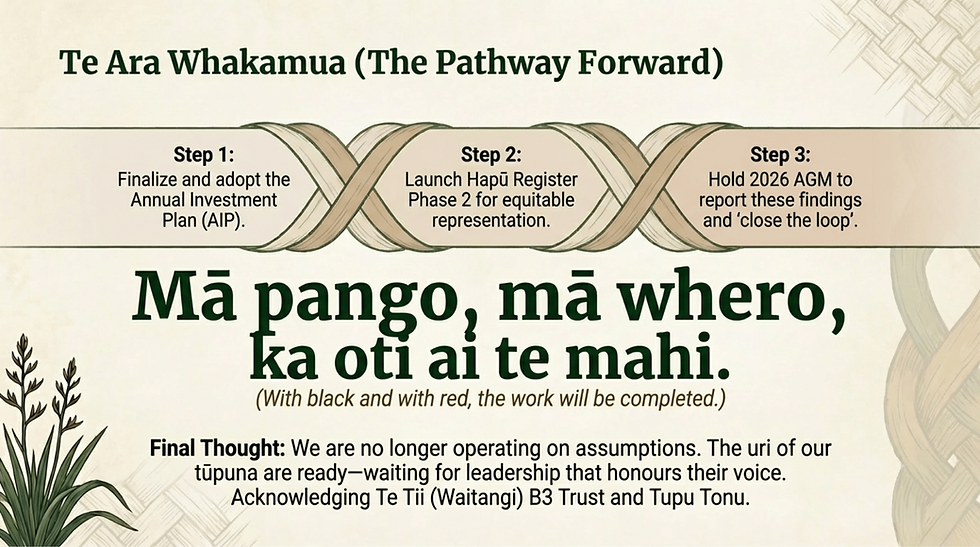
This work reflects a commitment to ensuring the voices of our people remain at the centre of our decision-making.
As the whakataukī reminds us:
Mā pango, mā whero, ka oti ai te mahi. With black and with red, the work will be completed.
See full presentation here:


